
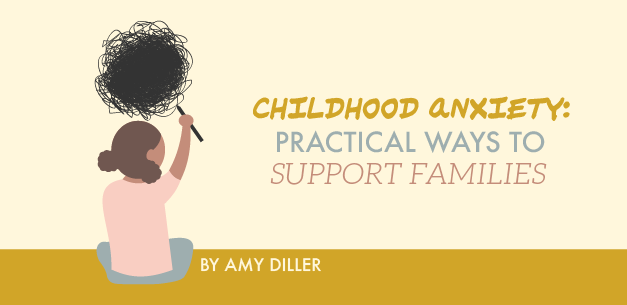
Childhood Anxiety: Practical Ways To Support Families
by Amy Diller
It’s Sunday morning drop-off time. Child #1 comes bounding into the room after giving parents the briefest of goodbyes and engages with peers and activities. All appears well with the world. Child #2 reluctantly approaches the door staying close to mom and dad for a while, and peeks into the room to see what’s going on inside. They are tentative at first, but after lots of reassurance from parents and the teacher, they enter the class and quietly watch the other children play. Child #3 comes howling down the hall adamantly and loudly, stating they will most definitely not go to class today or any Sunday following. The impending tantrum sprawls itself, kicking and screaming right outside the doorway. Which child is anxious?
Surprisingly, all three children could be affected by anxiety. It’s easy to identify the anxious behaviors in the second child. Typical symptoms are at play that make themselves evident. In the case of the first child, being at church feels safe and fun, but going to school triggers daily tummy aches. With the third child, it appears that someone either needs more sleep or more discipline, when in reality, anxiousness in children can come out in irritability and anger.
Although this example is a generalization, it does give a glimpse into the vast array of symptoms anxiety can cause in children. Frequent headaches, tummy aches, trouble sleeping, and fatigue can be physical indicators of anxiety, so can changes in behavior like anger, sadness, decreased concentration, or separation anxiety. Not every child who experiences these things is anxious, but these symptoms do ask us to look more closely for a root cause rather than dismissing them as a phase.
In order to be able to connect the dots, a child relies on the adults around them to pay close attention to what the physical and behavioral changes are trying to say. As a children’s ministry leader, you are part of the team who can assist families when anxious feelings overwhelm a child. The following are ways you can help children and their parents find a path to bring hope and healing to the child’s hearts and minds.
Assisting the Child
● Pour out empathy. Before talking about solutions with an anxious child, compassion and understanding should be offered generously. Starting with empathy validates a child’s feelings and tells them the adults in their lives will take care of them. Most importantly, you become the hands and feet of Jesus for a hurting child.
● Be sensitive to the needs of your kids. If a child is visibly afraid to stay in your care, don’t push. Invite parents to come in the room and stay with their child until he or she grows more comfortable. When parents leave, assure the child you will contact mom or dad if needed and follow through. Kids need reassurance that their parents are easily accessible.
● Facilitate connections. When a child feels anxious, it’s likely he or she also feels alone. Asking volunteers and other kids to offer compassion and companionship helps provide a support system around the child. Make introductions and talk about common areas of interest. Equip leaders and children with tools to help others feel welcome, especially those who are struggling.
● Pay attention to the environment. When we think about designing spaces for children, we often choose a high-energy focus – bright colors, big music, toys everywhere. These usually do appeal to children, but they can also overwhelm those dealing with anxiety. Focus some of your time and space on lower volumes, slower tempos, and strategically placed toys and activities.
Assisting the Parent
● Lead with empathy. Not only do anxious children need to feel our compassion and understanding, but parents do, too. When parents have a child dealing with anxiety, it can be very overwhelming and a heavy burden to carry. Trying to figure out how best to help their child can cause feelings of inadequacy. Your empathy can help soothe a parent’s troubled heart and demonstrate your desire to be a support as they walk through this journey with their child.
● Be an advocate. When parents trust you as an ally, you are positioned to share concerns with them. Out of care for their child, offer your observations. If you notice a change in a child’s behavior or demeanor, tell the parents. Chances are parents and/or teachers are also seeing similar signs. Part of helping a child deal with anxiousness is trying to find a root cause for their fears. Your insight may give parents new information to better understand what’s happening in the life of their child.
● Offer support. When a child is struggling, parents often think they’re the only ones dealing with this issue. It can be very lonely and lead to feelings of hopelessness. Support is so important in these seasons of parenting. If you are aware of families in a similar situation, especially those who have walked this path before, ask if they would be willing to share their story as encouragement to other parents. That connection may be invaluable.
● Be ready with resources. Utilize the materials we provide to you – parent videos, toolbox items, and articles. Take time to gather materials from other trusted sources to inform and give parents tools to help an anxious child. Create a list of professionals, especially those trained to work specifically with children, in your area to offer families if they need to enlist the help of a therapist or medical doctor.
All children will experience some level of anxiety; it’s more a matter of when it happens than if it happens. Hopefully, these tools will assist you in knowing how you might be a help. As you find yourself in the position to minister in this area, know that your empathy is the first step in caring for the needs of an anxious child. Surrounding parents and kids with your compassion and understanding as they navigate difficulty makes a meaningful difference in the life of a family.